
Porter’s Value Chain Analysis: How to Find, Fix, and Maximize Value in Any Business
Nov 25, 2025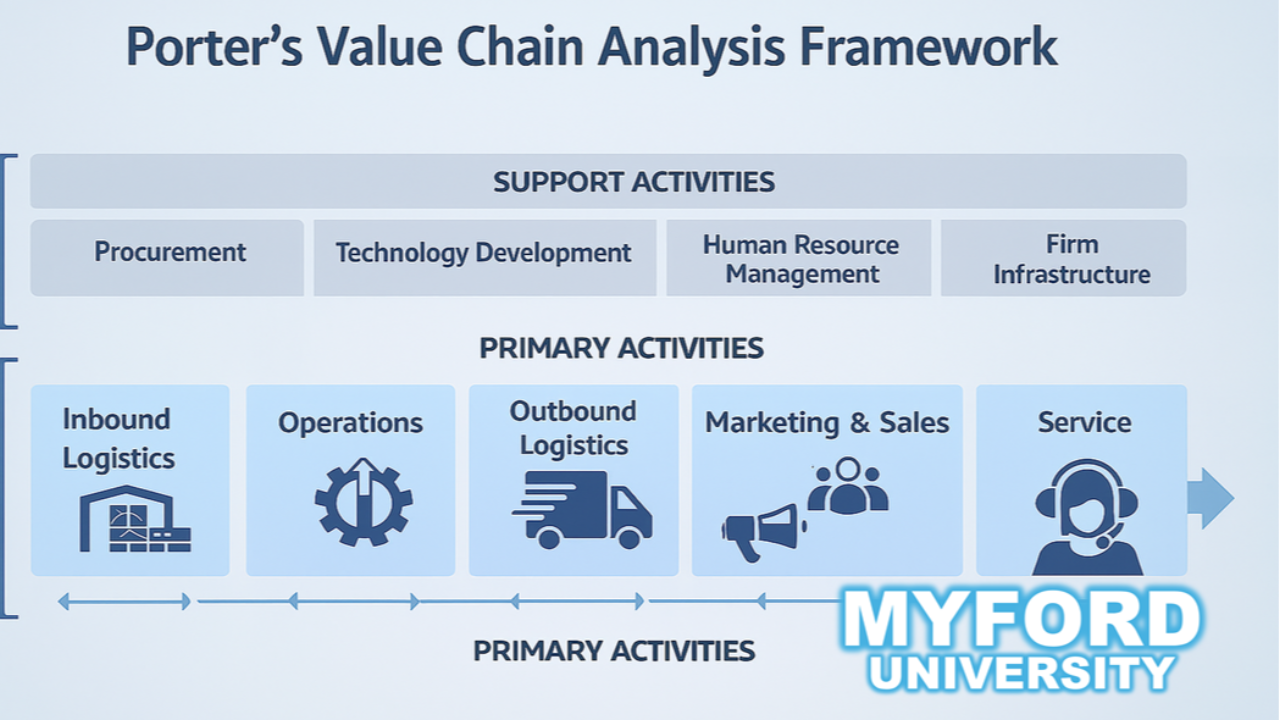
Introduction
Most people think about profit in one of two ways: sell more, or cut costs.
That’s simplistic—and often wrong.
Real profits come from understanding where value is created—and where it leaks. That’s what Porter’s Value Chain Analysis is all about. It’s a way to map out your entire business and see what’s actually contributing to your bottom line.
It answers one of the most important questions in business:
Where are we strong, where are we weak, and where can we get better?
At Myford University, we believe every serious businessperson—whether you’re a startup founder, operator, corporate manager, or solopreneur—should master this tool.
Let’s break it down using the Five W’s and One H format:
- What Is Porter’s Value Chain Analysis?
The Value Chain is a framework introduced by Michael Porter in his 1985 book Competitive Advantage. It breaks a business down into all the activities it performs to create value—both primary and support functions.
The idea is simple: every activity either adds value or subtracts it.
If you can map out each activity, analyze its cost and impact, and optimize it, you can increase margin without just raising prices or cutting heads.
Here’s how Porter split the activities:
🔹 Primary Activities (directly involved in creating and delivering the product):
- Inbound Logistics – Receiving, storing, and handling raw materials
- Operations – Turning inputs into the final product or service
- Outbound Logistics – Distributing the product to customers
- Marketing and Sales – Persuading customers to buy
- Service – Supporting the customer post-sale
🔹 Support Activities (indirect, but enable primary activities):
- Firm Infrastructure – General management, finance, planning
- Human Resource Management – Hiring, training, development
- Technology Development – R&D, IT, product design
- Procurement – Acquiring resources, tools, supplies
Each of these pieces either adds to your competitive advantage—or drags it down.
Value Chain Analysis is the process of mapping and analyzing these functions to find efficiency gains, cost reductions, differentiation opportunities, and strategic insight.
- Why Does Value Chain Analysis Matter?
Because value isn’t created in just one place—it’s created (and lost) everywhere.
Most businesspeople don’t realize:
- A poorly negotiated supplier contract (procurement) can wipe out your margin.
- Inefficient processes (operations) can kill scalability.
- Weak customer service (post-sale) can destroy repeat business.
- Underinvesting in employee training (HR) can stall growth.
The value chain makes every function visible, measurable, and improvable.
It also helps you answer:
- Where should we invest?
- Where are we bleeding value?
- What should we outsource?
- What’s our true differentiator?
In short: it helps you optimize your entire business—not just react to symptoms.
- Who Should Use It?
The Value Chain is useful for anyone responsible for business results. That includes:
- Entrepreneurs designing a scalable business model
- Operations managers looking for process improvements
- Consultants analyzing client bottlenecks
- Executives evaluating M&A targets
- Marketers trying to strengthen messaging and value prop
- Product leaders trying to understand cost and capability breakdowns
- Students or learners who want to think like operators, not just theorists
If you make decisions that impact cost, efficiency, or customer experience—you should be using this tool.
- When Should You Use It?
The Value Chain analysis isn’t just a one-time exercise. It’s a living diagnostic tool.
Use it when:
- Launching a new product, business, or operational unit
- Scaling up and need better systems
- Margins are shrinking and you’re not sure why
- Customers are churning or complaints are rising
- You’re preparing for an audit, investor review, or due diligence
- You're benchmarking against a competitor
Early-stage founders: Use it to map your ideal flow—even if some parts are manual today.
Mid-stage companies: Use it to scale operations and reduce waste.
Mature companies: Use it to stay lean, defend margins, and improve every function.
- Where Does Value Chain Analysis Apply in the Business?
Everywhere. Every function in the company is either part of the value chain—or supports it.
Let’s use an example of a coffee shop:
|
Function |
Real-Life Activity |
|
Inbound Logistics |
Buying beans, milk, cups, napkins from vendors |
|
Operations |
Brewing, prepping, cleanliness, barista speed |
|
Outbound Logistics |
Delivery, drive-thru, customer flow |
|
Marketing & Sales |
Loyalty cards, signage, social media, pricing |
|
Service |
Friendliness, complaint handling, follow-up |
|
HR |
Hiring baristas, training, retention |
|
Tech |
POS systems, mobile ordering |
|
Procurement |
Vendor negotiation, quality sourcing |
|
Infrastructure |
Lease, insurance, finance, management |
Every single one of these impacts customer experience, brand reputation, and profit.
Map it. Measure it. Optimize it.
- How to Do a Value Chain Analysis (Step-by-Step)
Let’s walk through a simple process you can apply to any business.
Step 1: Map Your Activities
Break your business down into the nine activities from Porter’s model:
- 5 primary
- 4 support
List the specific tasks, processes, systems, and people involved in each.
Example: Under “Operations,” list:
- Manufacturing process
- Assembly line
- Quality control
- Software builds (for tech companies)
Step 2: Identify Costs and Value for Each Activity
Ask:
- What does this activity cost us (time, money, effort)?
- Does it add value customers will pay for?
- Is it a source of competitive advantage—or a liability?
Use real data if you have it—otherwise, start with estimates. You’re looking for outliers, inefficiencies, and missed opportunities.
Step 3: Benchmark Against Competitors
Where are your competitors stronger or leaner?
Ask:
- Do they have a more efficient supply chain?
- Are their operations more automated?
- Is their customer service world-class while yours is average?
If you can’t compete head-to-head, consider differentiation—or partnership, outsourcing, or system upgrades.
Step 4: Identify Opportunities to Improve
For each activity, look for:
- Redundancy or waste
- Manual work that could be automated
- Steps that customers don’t value
- Ways to speed up, improve, or reduce cost
Then prioritize fixes based on:
- Impact on profit
- Ease of implementation
- Strategic importance
Step 5: Reconfigure Your Value Chain if Needed
Sometimes, small fixes aren’t enough. You may need to rebuild part of the chain.
Examples:
- Move from physical to digital delivery
- Outsource logistics to Amazon or ShipBob
- Automate operations with AI or SaaS tools
- Shift to self-service onboarding in software
This is where strategy meets execution.
Case Study: Software-as-a-Service (SaaS) Business
Let’s apply the Value Chain to a SaaS company selling a productivity app:
|
Activity |
Example |
Optimization Idea |
|
Inbound Logistics |
Data integrations, API tools |
Streamline onboarding w/ templates |
|
Operations |
Development, testing, hosting |
Automate QA, migrate to scalable cloud |
|
Outbound Logistics |
App download, browser access |
Improve load speed, multi-device support |
|
Marketing & Sales |
Website, demo videos, content marketing |
A/B test pricing, better CTAs |
|
Service |
Live chat, support tickets |
Add knowledge base, chatbot triage |
|
Infrastructure |
Finance, compliance, leadership |
Monthly KPI dashboards, lean ops |
|
HR |
Engineering hires, remote team support |
Improve onboarding, async tools |
|
Tech Development |
Continuous product updates |
Ship faster via CI/CD pipelines |
|
Procurement |
API vendors, software tools |
Negotiate volume discounts or replace |
This value chain reveals where customer experience breaks down (slow support), where costs creep (third-party tools), and where growth levers exist (marketing optimization).
Final Thoughts: Don’t Just Operate—Optimize
Porter’s Value Chain Analysis gives you a full-body X-ray of your business. It helps you:
- Find weak links
- Reduce waste
- Improve flow
- Enhance margins
- Strengthen competitive advantage
Most businesses don’t fail because of one big mistake.
They fail because of a thousand little value leaks no one ever addressed.
Use this model to plug the leaks and build something that runs clean and strong.
At Myford University, we’re not just about theory—we’re about rapid, applied learning.
The Value Chain is a thinking tool, a planning tool, and an execution tool all in one.
So print it out. Map your business. Start asking better questions.
Don’t just run a business—build a system that delivers value at every step.
Stay connected with news and updates!
Join our mailing list to receive the latest news and updates from our team.
Don't worry, your information will not be shared.
We hate SPAM. We will never sell your information, for any reason.