
How to Use the Scientific Method Personally and Professionally (Even If You're Not a Scientist)
Nov 11, 2025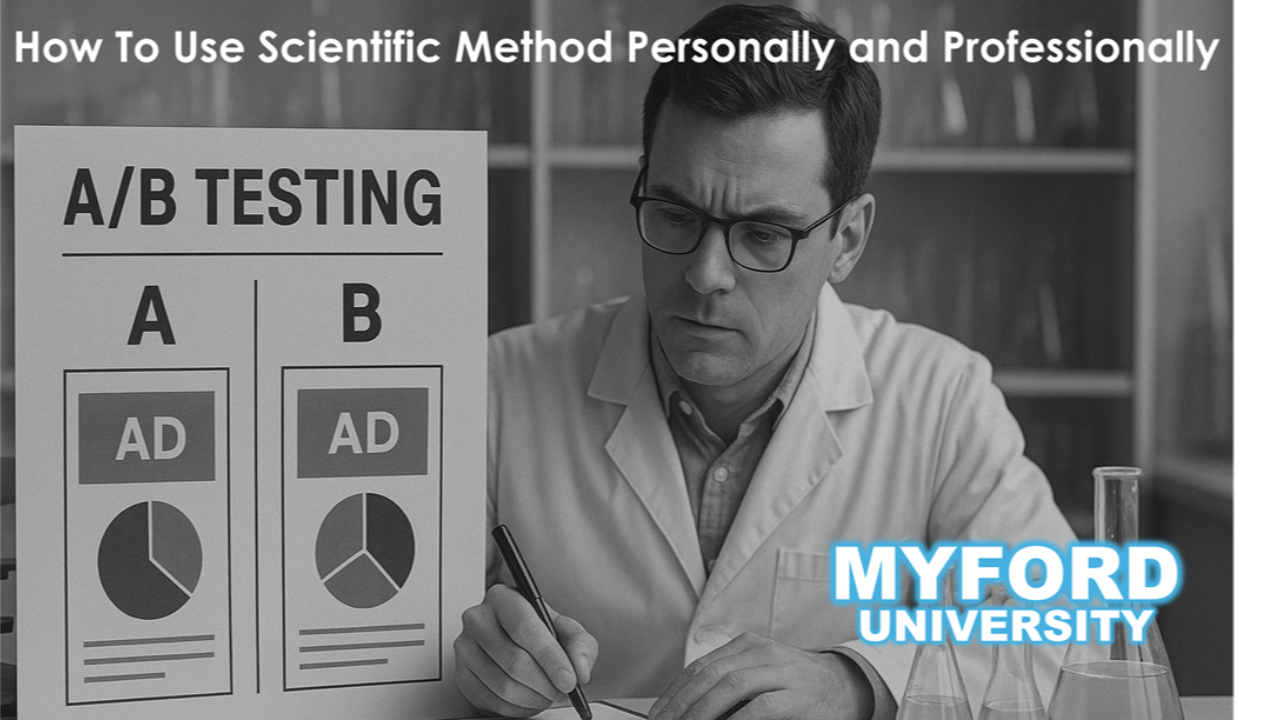
The Scientific Method Is for You — Yes, You.
You don’t need a lab coat or a PhD to use the most powerful improvement tool ever created. Whether you're running a business, building a side hustle, working a corporate job, or trying to improve your life—this method works. And it’s probably already hiding behind the jargon you hear every day: beta test, A/B test, pilot, trial run, split testing, and so on.
"But George, I’m Not a Biologist or a Chemist!"
Exactly. That’s why you need to hear this even more.
If you’re trying to build something, grow something, improve something, or solve a problem—you’re in the business of experimentation. And like it or not, that makes you a kind of scientist.
You don’t need to wear goggles. You don’t need a microscope. And you sure as hell don’t need permission from academia.
But you do need a framework to think clearly, test your assumptions, and make better decisions.
That framework is the Scientific Method.
Why You Should Care: The Method That Built the Modern World
The Scientific Method isn’t just a classroom exercise. It’s the foundation of nearly every innovation you rely on today—from electricity to airplanes to antibiotics to iPhones.
But outside of labs and classrooms, the method got renamed.
In business? It’s A/B testing.
In software? It’s a beta launch.
In marketing? It’s split testing.
In personal development? It’s trial and error (hopefully with a little more structure).
In lean startups? It’s called Build–Measure–Learn.
Same engine. Different paint job.
What Is the Scientific Method?
Let’s keep it simple and practical.
The Scientific Method is a repeatable process for figuring things out and making better decisions. It's built on one central principle:
Don’t assume. Test.
Here’s how it breaks down:
- Observation – Notice something. Identify a problem or pattern.
- Question – Ask: Why is this happening? What could be improved?
- Hypothesis – Make an educated guess: If I do X, then Y will happen.
- Experiment – Test your guess with a real-world action or trial.
- Analyze – Did it work? What happened? What does the data say?
- Conclusion – What did you learn? What do you do next?
Then? You repeat. Improve. Evolve. Iterate.
This isn’t just a framework. It’s a way of thinking. It forces you to confront reality, take action, and let evidence drive your decisions—not ego, not guesswork.
So How Does This Apply to Your Life or Business?
Let’s get specific.
- Sales and Marketing
You’re running ads. Which headline works better? Which offer converts more?
Hypothesis: “If we highlight the discount first, more people will click.”
Experiment: Run two versions of the ad (A/B testing).
Analyze: Which got more conversions?
Conclusion: Use the winning version—or test again to improve further.
You’re already doing it—or you should be. This is science in action.
- Product or Service Design
Want to launch a new service or product?
Hypothesis: “If we offer a one-day delivery option, customers will pay more.”
Experiment: Offer it to 50 customers. Track uptake.
Analyze: How many chose it? What did they say?
Conclusion: Keep it? Kill it? Modify it?
This is why tech companies launch in “beta.” Not because it’s trendy. Because it’s scientific.
- Career Decisions
Thinking about switching jobs, asking for a raise, or taking on a new role?
Instead of sitting on the fence, you experiment.
Hypothesis: “If I learn Power BI, I’ll qualify for better-paying jobs.”
Experiment: Take a short course, update your resume, and apply.
Analyze: Do you get more callbacks? Better offers?
Conclusion: Continue or pivot.
Apply the same thinking to promotions, career shifts, or side hustles.
- Personal Life
Trying to lose weight, improve sleep, or increase focus?
Most people wing it. You won’t.
Hypothesis: “If I cut sugar after dinner, I’ll sleep better.”
Experiment: Try it for a week.
Analyze: Track sleep quality and energy.
Conclusion: Adjust accordingly.
This is how real change happens. Not from reading more tips—but from structured, tested actions.
Why Most People Fail: No Hypothesis, No Test, No Learning
Here’s what most people do:
- They observe a problem.
- They jump to action without testing.
- They fail, then get discouraged.
- They never isolate what worked (or didn’t).
- They blame themselves or others.
That’s not the scientific method. That’s emotional reactivity pretending to be improvement.
The scientific method is slow, deliberate, structured, and objective. That’s why it works.
You don’t get married to your idea. You test it. Learn. Adjust. Improve.
The Hidden Power: It Removes Ego and Builds Confidence
Here’s the underrated benefit: it gets you out of your own head.
Instead of wondering:
- “Am I good enough?”
- “What if I fail?”
- “Will people laugh at me?”
You ask:
- “What does the data say?”
- “What did I learn?”
- “What will I test next?”
It turns self-doubt into self-improvement. It puts you in motion instead of paralysis. It forces reality to weigh in—objectively, not emotionally.
And here’s the wild thing: when you think like a scientist, your confidence goes up—because you’ve got proof, not just hopes.
Common Excuses (And Why They Don’t Hold Up)
“I’m not smart enough.”
Yes, you are. If you can ask a question, make a guess, and try something—you can use the scientific method.
“I don’t have data.”
Then start collecting. Start small. Write things down. Track what happens. That’s data.
“I don’t have time.”
You’re already making decisions. Wouldn’t you rather make better ones?
“I’m not a scientist.”
Exactly. You’re not trying to publish a peer-reviewed paper. You’re trying to get real-world results. This is science for real life.
The Scientific Method vs. Gut Feel: You Need Both
Gut feel is valuable—especially when based on experience. But it’s not enough.
The smartest operators—business owners, investors, consultants, doctors—test their gut. They don’t bet everything on a hunch. They experiment.
Use instinct to generate ideas. Use the scientific method to validate them.
Gut without method = wild guessing
Method without gut = sterile, uninspired testing
Together? That’s powerful.
What’s the Alternative? Blind Guessing, Wasted Time, and Missed Opportunities
If you don’t test, here’s what you get:
- Long projects that fail without warning.
- Product launches that flop because you assumed people wanted it.
- Campaigns that burn money because you guessed wrong.
- Personal changes that don’t stick because you never tracked anything.
You don’t need to live like that.
Use the method.
You Already Know This Works: Everyday Examples
- Job hunting: You tweak your resume. You try different versions. You analyze who calls back. That’s A/B testing.
- Fitness: You try eating clean for a week. You measure energy. That’s experimentation.
- Online business: You test a $49 vs. $97 price point. You see which one sells better. That’s split testing.
What you may not be doing is systematizing it.
Start doing that now. Make it deliberate. Make it powerful.
Make It a Habit: How to Use the Scientific Method in Daily Life
Here’s your mini-playbook for using this method:
Step 1: Write Down the Problem or Goal
Be specific. Don’t just say “Sales are low.” Say, “Sales dropped 22% in the last 30 days on Product X.”
Step 2: Ask a Better Question
Why is this happening? What’s changed? What’s the bottleneck?
Step 3: Form a Hypothesis
“If I change the headline, click-through rate will increase.”
Step 4: Design a Simple Test
Run two versions. Or try a pilot. Or give yourself one week to test.
Step 5: Track the Result
Use numbers. Track metrics. Journal it. Use screenshots. Proof matters.
Step 6: Learn and Adjust
What worked? What didn’t? What’s your next test?
Repeat.
Over time, you’ll become sharper, faster, and more effective.
Bonus: How to Use It With a Team
If you’re a leader or manager, this is gold.
Stop debating. Start testing.
Instead of:
“I think this will work.”
Say:
“Let’s test it. Let’s see what the data says.”
You eliminate drama. You build a culture of learning. You build respect—because everyone knows that results matter more than ego.
Use Cases for Knowledge Workers and Entrepreneurs
- Freelancers: Test pricing structures. Test service packages.
- Consultants: Test lead generation channels. Test presentations or sales decks.
- Creators: Test content formats. Test posting times.
- Managers: Test process improvements. Test incentive plans.
Each test makes you better. Each insight compounds.
Real Talk: It’s Not Always Fun, But It’s Always Worth It
Let’s be honest. This process takes effort.
You’ll need discipline. Documentation. Honesty. A willingness to be wrong.
But here’s the upside: You’ll waste less time. You’ll learn faster. You’ll win more often.
And you’ll outpace your competitors—because most of them are still winging it.
Final Word: The Scientific Method Is the Ultimate Life Skill
At Myford University, we teach people to think for themselves, to act with intention, and to learn by doing.
This method? It checks every box.
- It’s practical.
- It’s results-driven.
- It puts you in control.
- And it scales with your ambition—personally or professionally.
So next time you’re facing a challenge, don’t ask, “What should I do?”
Ask:
“What can I test?”
That’s the real question that leads to better results.
Summary Checklist: Scientific Method for Everyday Use
✅ Observe – What’s happening? What’s the problem?
✅ Question – Why? What could fix this?
✅ Hypothesis – If I do X, then Y will happen.
✅ Experiment – Try something specific.
✅ Analyze – Measure the result.
✅ Conclude – What worked? What’s next?
Call to Action
Stop assuming. Start testing. That’s how you grow.
The Scientific Method isn’t just for scientists. It’s for business owners, side hustlers, creatives, employees, leaders, and learners.
It’s for you.
Use it. Improve. Repeat.
Stay connected with news and updates!
Join our mailing list to receive the latest news and updates from our team.
Don't worry, your information will not be shared.
We hate SPAM. We will never sell your information, for any reason.