
The Sunk Cost Trap: Why We Stick With Bad Decisions and How to Break Free
Dec 02, 2025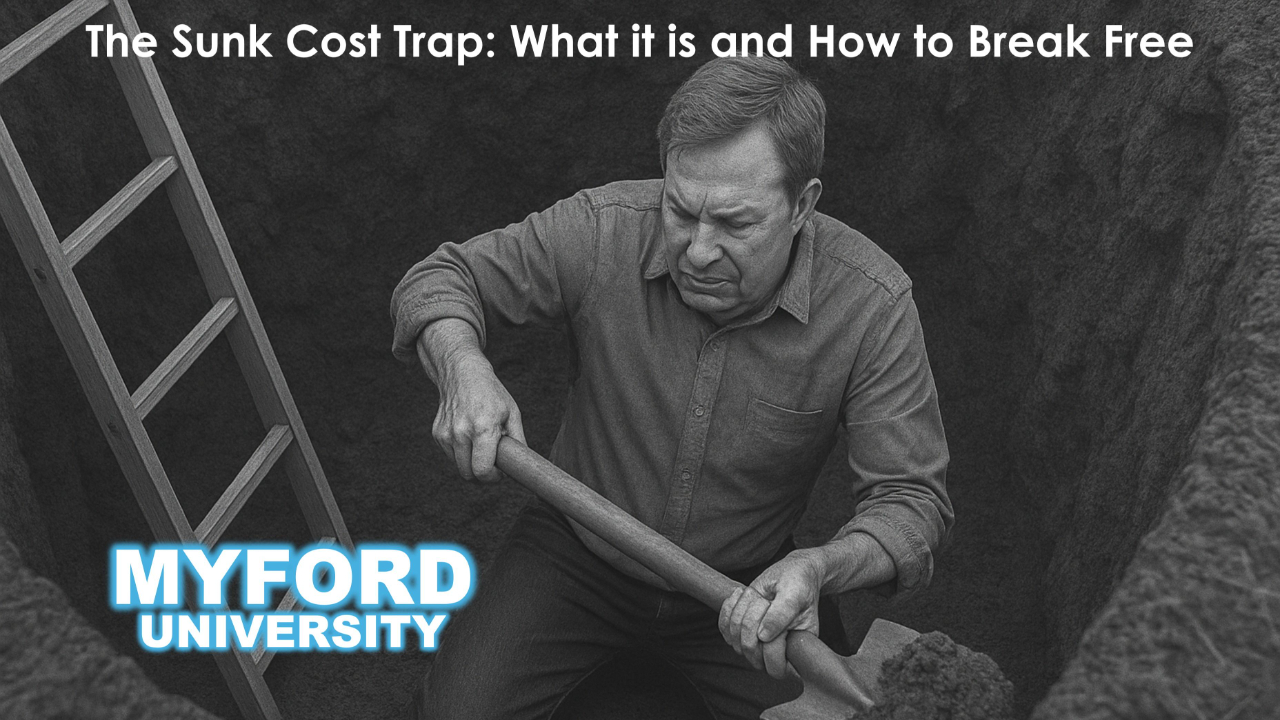
“Throwing good money after bad.”
“I’ve already put so much time into this.”
“I don’t want to waste what I’ve invested.”
Sound familiar?
These aren’t rational strategies—they’re symptoms of one of the most dangerous thinking errors in both business and life: the sunk cost trap.
Today, we’ll explore:
- What the sunk cost trap is (and why smart people fall for it)
- Real-life examples—from MBA degrees to failing projects
- The psychology behind our poor decisions
- How to break free using proven mental models
- When to quit, when to continue, and how to tell the difference
Let’s begin.
Part I: What Is the Sunk Cost Trap?
A sunk cost is any resource—time, money, effort—that you've already spent and cannot recover.
The trap is when you let that past investment influence your future decisions, even when continuing doesn’t make sense.
You’ve already paid for it. It’s gone. But you act like you can still get your money’s worth—by doubling down.
Here’s the problem:
Sunk costs are irrelevant to rational decision-making.
Only future costs and benefits should guide your next move.
But our brains hate waste. We want closure. We want the original plan to work—so we keep pouring more into a broken strategy.
Part II: The Sunk Cost Trap in Action – Personal Examples
🎓 Example 1: Pursuing a College or MBA Degree You No Longer Want
You’re two years into a four-year degree—or halfway through your MBA. You realize this path isn’t for you. The subject doesn’t excite you. The outcomes don’t align with your goals. Maybe you’ve already landed a job that doesn’t even require the degree.
But you keep going anyway.
Why?
Because you already spent tens of thousands of dollars and hundreds of hours.
That’s the sunk cost trap. You’re investing not because it’s the best move now, but because you’ve already invested so much before.
Better question: If you weren’t already enrolled, would you sign up for this degree today?
If not—you may be in the trap.
💔 Example 2: Staying in a Relationship That Isn’t Working
You’ve been together for years. You’ve built routines. Maybe shared finances. You’ve put in so much effort.
But deep down, you know it’s not a healthy or fulfilling relationship.
Still—you tell yourself, “I’ve already put in five years. I can’t walk away now.”
Yes, you can.
And if you don’t, you risk throwing another five years into something you already know isn’t right.
Part III: The Sunk Cost Trap in Business
💼 Example 1: A Failing Product
Imagine you’ve spent six months and $500,000 developing a new product.
But the market doesn’t want it. Sales are low. User feedback is negative.
Instead of shutting it down, the team pushes forward—adding more features, more ads, more budget.
Why?
Because of what they’ve already spent.
But what they should be asking is:
Would we start this product today, knowing what we know now?
If the answer is “no,” the rational decision is to stop.
🏢 Example 2: A Bad Hire or Vendor
You hired someone senior. They’re underperforming. Everyone knows it.
But leadership hesitates to let them go. They say, “We spent months recruiting them. We offered a big salary. We’ve onboarded them already.”
So instead of replacing them, they assign more coaching. More second chances. More patience.
Result? Team morale declines. Projects stall. The damage multiplies.
All to avoid admitting a mistake—and wasting the initial investment.
Part IV: Why We Fall for It – The Psychology of the Trap
🧠 1. Loss Aversion
We fear losses more than we value gains. Giving up on something we invested in feels like losing twice.
But in truth, the loss already happened. It’s over. What matters now is what gets you the best future return.
🧠 2. Ego and Identity
Quitting can feel like failure. We don’t want to admit we were wrong—especially publicly.
So we cling to our choices. Our egos say, “I’m not a quitter.”
But pivoting isn’t quitting. It’s smart. The brave thing isn’t always pushing forward. Sometimes it’s walking away.
🧠 3. Escalation of Commitment
Once we start down a path, we keep investing—even when evidence says stop. It’s a vicious cycle.
“One more push, and it’ll turn around.”
“We’re too far in to stop now.”
That’s when smart people make dumb decisions.
Part V: How to Break Free – Practical Tools and Questions
Let’s fix this.
Here’s how to avoid or escape the sunk cost trap in real time.
🔍 1. Ask This One Question
“Knowing what I know now, would I start this again today?”
If the answer is no, you may need to walk away—even if it hurts.
🔄 2. Use the OODA Loop
- Observe the facts.
- Orient to the new reality.
- Decide based on future value, not past effort.
- Act swiftly to change direction.
Loop again as needed.
🧠 3. Practice First Principles Thinking
Strip away the history. Forget what you already spent.
Ask:
- What is the actual goal?
- What’s the best path forward from here?
- If I were advising someone else in my position, what would I tell them to do?
💡 4. Build a Stop-Loss Rule
Just like investors set limits on how much loss they’ll tolerate before selling, you should set your own rules:
- “If this project doesn’t show X by Y date, we shut it down.”
- “If I don’t feel excited about this class in 30 days, I withdraw.”
These safeguards prevent emotional decision-making later.
🧾 5. Conduct a “Cost to Continue” Analysis
Forget what you’ve already spent.
Instead, ask:
- What will it cost to keep going—time, money, opportunity cost?
- What’s the most valuable use of those resources right now?
If the current path isn’t the best ROI going forward, switch paths.
Part VI: When It’s Right to Continue
To be clear—not every situation that looks like a sunk cost is one. Sometimes sticking with it is right.
Here’s when it makes sense to push forward:
- You’ve validated the idea or direction—progress is slow but real.
- The feedback loop is working and improving over time.
- You have a long-term strategic reason for staying the course.
- You’ve accounted for sunk costs but decided to continue anyway based on future benefit.
Persistence is a virtue—but only when the destination is still worth it.
Part VII: A College and MBA-Specific Lens
🎓 The College Student Example
Let’s say you’re 3 semesters into a business degree.
You’ve discovered you hate accounting, dislike the structure of formal education, and love hands-on entrepreneurship.
But you stay because you’ve already racked up 60 credits and $40,000 in debt.
Here’s a truth bomb:
That $40k is gone. Staying may only add to your loss if the degree won’t help you reach your goal.
Sometimes the better move is to pause, pivot, or switch programs—and build real-world skills, start a business, or pursue certificates that fit your goals.
🎓 The MBA Candidate Example
You’re halfway through a traditional MBA program. You realize the content is outdated, professors haven’t run real businesses, and your dream job doesn’t even require the degree.
But you think, “I’ve already spent $60K and 12 months—I might as well finish.”
Be careful.
Ask:
- What is the remaining cost—in time, tuition, lost income?
- What could you do with that time and money instead?
If a faster, cheaper alternative (like an intensive 8–12 hour MBA accelerator) gives you more ROI and gets you back to earning sooner—you’re not quitting. You’re optimizing.
Part VIII: Final Thoughts – Don’t Let Yesterday Hijack Tomorrow
The sunk cost trap is sneaky. It whispers that quitting is failure, that walking away is wasteful, and that more effort will fix everything.
But smart, strategic people—people like you—know better.
You know that:
- What you’ve spent is gone.
- What matters is what comes next.
- Every minute, dollar, or ounce of energy spent on the wrong thing is a minute, dollar, or ounce not spent on the right one.
Cut your losses. Protect your future. Pivot with pride.
Because you’re not here to honor the past.
You’re here to build the future.
Stay connected with news and updates!
Join our mailing list to receive the latest news and updates from our team.
Don't worry, your information will not be shared.
We hate SPAM. We will never sell your information, for any reason.